TWO:Yet, supposing it were proved to-morrow that punishment fails entirely of the ends imputed to it; that, for example, the greater number of crimes are[80] committed by criminals who have been punished already; that for one chance of a man¡¯s reformation during his punishment there are a hundred in favour of his deterioration; and that the deterrent influence of his punishment is altogether removed by his own descriptions of it; shall we suppose for a moment that society would cease to punish, on the ground that punishment attained none of its professed ends? Would it say to the horse-stealer, ¡®Keep your horse, for nothing we can do to you can make you any better, nor deter others from trying to get horses in the same way?¡¯
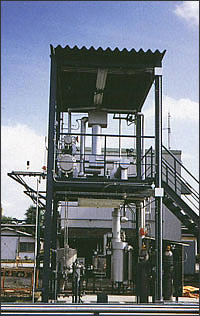
Great attention is recently being paid to global environmental issues, and it is now conceivable that companies will need to treat used solvents themselves. In consideration of this kind of social issue, we have developed a “membrane separation type solvent dehydration system,” which uses a polyimide membrane with superior dehydration properties developed by Ube Industries, Ltd. in combination with our own distillation and concentration technology that has resulted in solvents being more easily recovered.
THREE:This honour, then, is one of those complex ideas[210] which are an aggregate not only of simple ideas but of ideas no less complex than themselves, and which in their various presentments to the mind now admit and now omit some of their different component elements, only retaining some few common ideas, just as in algebra several complex quantities admit of a common divisor. To find this common divisor in the different ideas that men form of honour, we must cast a rapid glance over the first formation of communities.The most successful adoption of Beccaria¡¯s principles of punishment occurred in Tuscany, under the Grand Duke Leopold. When he ascended the ducal throne, the Tuscans were the most abandoned people of all Italy. Robberies and murders were none the less frequent for all the gallows, wheels, and tortures which were employed to repress them. But Leopold in 1786 resolved to try Beccaria¡¯s plan, for which purpose he published a code, proportioning punishments to crimes, abolishing mutilation and torture, reducing the number of acts of treason, lessening confiscations, destroying the right of asylum, and above all abolishing capital punishment even for murder. The result was, says a contemporary, that Tuscany, from having been the land of the greatest crimes and villanies, became ¡®the best ordered State of Europe.¡¯[22] During twenty years only five murders were committed in Tuscany, whilst at Rome, where death continued to be inflicted with great pomp, as[36] many as sixty were committed within the space of three months.[23]
- 1Under the distillation system, even in case of azeotropic solvent compositions, this system which remove water vapor by the polyimide membrane will easily dehydrate.
- 2In comparison with the distillation system, it significantly saves on use of steam.
- 3Dehydration can be performed through merely supplying evaporated vapor to the membrane module and maintaining the differential pressure between the permeable side and the impermeable side.
- 4Solvent purity of 99.9% or more can be achieved by carrying out dehydration with a polyimide membrane only.
- 5The polyimide membrane has superior heat and solvent resistance. Therefore, the vapor permeation system reduces contamination of the membrane and thus extends its life.
THREE:But why does this crime never entail disgrace upon its author, seeing that it is a theft against the prince, and consequently against the nation? I answer, that offences which men do not consider can be committed against themselves do not interest them enough to produce public indignation against their perpetrator. Smuggling is an offence of this character. Men in general, on whom remote consequences make very feeble impressions, do not perceive the harm that smuggling can do them, nay, often they enjoy a present advantage from it. They only perceive the injury done to the sovereign; they are not interested, therefore, in withdrawing their favour from a smuggler as much as they are in doing so from a man who commits a theft in private life, who forges a signature, or brings upon them other evils. The principle is self-evident, that every sensitive being only interests himself in the evils which he knows. This crime arises from the law itself; since the benefit it promises increases with the increase of the import duty, and therefore the temptation and the facility of committing it increases with the circumference of territory to be guarded and the small size of the prohibited wares. The penalty of losing both the prohibited goods, and whatever effects are found with them, is most just; but its efficacy will be greater in proportion as the import duty is lower, because men only incur risks relative to the advantage derivable from the prosperous issue of their undertaking.
The aromatic polyimide membrane is highly permeable to water vapor but less permeable to vapors of organic compounds such as alcohol etc.
THREE:It is not true that the sciences have always been injurious to mankind; when they were so, it was an inevitable evil. The multiplication of the human race over the face of the earth introduced war, the ruder arts, and the first laws, mere temporary agreements which perished with the necessity that gave rise to them. This was mankind¡¯s primitive philosophy, the few elements of which were just, because the indolence and slight wisdom of their framers preserved them from error. But with the multiplication of men there went ever a multiplication of their wants. Stronger and more lasting impressions were, therefore, needed, in order to turn them back from repeated lapses to that primitive state of disunion which each return to it rendered worse. Those primitive delusions, therefore, which peopled the earth with false divinities and created an invisible universe that governed our own, conferred a great benefit¡ªI mean a great political benefit¡ªupon humanity. Those men were benefactors of their kind, who dared to deceive them and drag them, docile and ignorant, to worship at the altars. By presenting to them objects that lay beyond the scope of sense and fled from their grasp the nearer they seemed to approach them¡ªnever despised, because never well understood¡ªthey concentrated their divided passions upon a single object[247] of supreme interest to them. These were the first steps of all the nations that formed themselves out of savage tribes; this was the epoch when larger communities were formed, and such was their necessary and perhaps their only bond. I say nothing of that chosen people of God, for whom the most extraordinary miracles and the most signal favours were a substitute for human policy. But as it is the quality of error to fall into infinite subdivisions, so the sciences that grew out of it made of mankind a blind fanatical multitude, which, shut up within a close labyrinth, collides together in such confusion, that some sensitive and philosophical minds have regretted to this day the ancient savage state. That is the first epoch in which the sciences or rather opinions are injurious.The result, then, of torture is a matter of temperament, of calculation, which varies with each man according[152] to his strength and sensibility; so that by this method a mathematician might solve better than a judge this problem: ¡®Given the muscular force and the nervous sensibility of an innocent man, to find the degree of pain which will cause him to plead guilty to a given crime.¡¯
- 1 Recovery of the detergent solvent Recovery of the cleaning solvent such as electronic parts industry, precision instrument industry.
- 2Solvent recovery and the refinement Solvent recovery and the refinement such as chemical industry, an industry of medical supplies, food industry, the fermentation industry.
THREE: Our laws prohibit suggestive (leading) questions in a lawsuit: those, that is (according to the doctors of law), which, instead of applying, as they should do,[145] to the genus in the circumstances of a crime, refer to the species; those, in other words, which from their immediate connection with a crime suggest to the accused a direct answer. Questions, according to the criminal lawyers, ought, so to speak, ¡®to envelop the main fact spirally and never to attack it in a direct line.¡¯ The reasons for this method are, either that an answer may not be suggested to the accused which may place him face to face with the charge against him, or perhaps because it seems unnatural for him directly to criminate himself. But, whichever of these reasons it may be, the contradiction is remarkable between the existence of such a custom and the legal authorisation of torture; for what interrogatory can be more suggestive than pain? The former reason applies to the question of torture, because pain will suggest to a strong man obstinate silence, in order that he may exchange the greater penalty for the lesser, whilst it will suggest to a weak man confession, in order that he may escape from present torment, which has more influence over him than pain which is to come. The other reason evidently applies too, for if a special question leads a man to confess against natural right, the agonies of torture will more easily do the same. But men are more governed by the difference of names than by that of things.
Acetone, ethanol, methyl ethyl ketone, butanol, isopropyl alcohol, ethyl acetate, methyl isobutyl ketone, others (including hexane and toluene).
